1268 words [ 39 Screenshots ] [ 8 Versions ] [ 1 Weblinks ] - Last update: 2023-12-22 Page created: 2005-07-23 [SB]
Windows Vista
 Microsoft published the new product name Vista for this new Windows Version on an event in the USA/Atlanta on 21-07-2005. This Windows Version was known under the development name Longhorn before. The installation of Vista is based on WIM (Windows Imaging format), a file-based Image Format. It compresses the contained files and can be used for the installation on several platforms from the same Image. The image on the DVD contains a pre-installation of the system directories of Windows in the Windows Imaging (.WIM) file and adapts to the hardware configuration. With the User State Migration Toolkit the user defined settings can be imported of Windows 2000 and Windows XP. An advantage of WIM images is the easy integration of new drivers and updates, the LZX compression provides the smallest file size and XPress compression the fastest compression. The installation DVD of Windows Vista already contains about 16,000 drivers, the Windows update offers further 14,000 drivers for supported hardware. There is no licence key during the Windows Vista installation necessary, in this case it start with a 30 days trial license. After this time period the activation of the operating system is inevitably with the Internet Explorer, after the start-up Windows opens only this window for activation. Windows Vista contains DRM technology for the playback of protected multimedia files.
Windows Vista (Windows version 6.0) contains the new user interface Aero. The start menu has a round start button without text now. New characteristics are three-dimensional effects, the transparent representation and freely scalable symbols. To see all visual features a graphiccard with DirectX 9.0 support is required. The known interface of Windows XP can be activated alternatively. The PC should at least contain a processor with 2 ghz, 512 mbyte RAM and at least 10 GByte of free harddisk storage.
Developer take advance from the new graphic interface WPF (Windows Presentation Foundation) for the component-based development of 2D and 3D applications, WPF was designed under the code name Avalon. This framework supports the use of vector graphic for better scaling of applications on the display screen.
For better Security Microsoft has integrated useful functions. The automatic update of the operating system provides the installation of new patches. When required the function UAC (User Account Control) asks the user whether it shall unlock unlimited user rights for the execution of a program. InfoCards makes the automated log-on and register of login informations for web pages possible. Windows Defender extends Windows by an spyware/malware protection, the Windows Firewall monitors connections which are incoming and outgoing.
The performance is for a shorter reactivation time of Windows with the active programmes after a cold start of the PC improved by Windows SuperFetch. Windows ReadyBoost provides an additional working memory on USB flash devices and can be combined with SuperFetch. The USB flash storage has much faster access times than hard disks.
Preinstalled Programs by Microsoft were updated. The Internet Explorer 7 contains a Phishing Filter opposite to the previous version and supports Tabbed Browsing. The navigation in the Windows Explorer was revised, the address bar is equipped with single-line option fields displays for faster navigation in the directories on the file system. The search after files is possible with the use of many filters. Outlook Express was renamed in Windows Mayl and got version 7.0 now. The functions of the Windows Media Player 11 and Windows Movie Maker were refined.
Microsoft announced the product versions for Windows Vista on 2006-02-26. Altogether there are 6 versions which are different in product functions and price. The same characteristic is the maximum support of 4 gbyte RAM for all 32-bit versions. For Windows Vista 64-bit and Home Basic are already 8 gbyte supported, Home Premium 16-gbyte, for the business variants and Vista Ultimate more than 128 gbyte RAM.
The Windows Vista Starter Edition is targeted to technological developing countries at a low price and fewer program functions. Only the Vista Basic graphical interface and 32-bit version is available, the number of simultaneously executable applications is limited to 3. Windows Vista Home Basic for private users contains only the simple user interface and cames without different new effects of the Aero interface. A new function is the content and access control with protection of children and young people for the restricted use of Windows and display of web sites. The next higher version is Windows Vista Home Premium which can also show the new Windows Aero interface. Aero offers a simpler search for files in the audio and video format. Additional functions belongs to the Windows Media Center to convert the computer into a multimedia player. The field of application is enhanced by the Windows Tablet PC technique like hand character recognition, support of digital pins and finger touch recognition. The storage medium DVD can be described over the integrated burning function with data, the authoring software helps at the creation of own films.
The Basic version for enterprise use forms the Windows Vista Business edition. The Windows Aero user interface can be activated, Windows Tablet PC technique like hand character recognition is also included. The administration of many documents is improved, file encrypting and the Encrypting File System (EFS) are important security extensions. For mobile use are designed the PC to PC synchronization and other mobile functions. The domain logon and group guidelines is part of the network component. Data security is provided by the image based backup. Windows Vista Enterprise has the same functions as the Business Edition and contains in addition Windows BitLocker for hard disk encrypting and Virtual PC Express for the compatibility to older Windows applications by the creation of a virtual environment. The subsystem for UNIX allows the execute of UNIX applications without porting. Windows Vista Ultimate contains all features of the other versions but is the most expensive Edition.
Microsoft published the first Service Pack for Windows Vista in March 2008. It is distributed over the automatic Windows Update one month later. If Vista is not activated the further use is possibly now without restrictions, but message windows remember the missing activation. Major changes are the support of UEFI, DirectX 10.1, the new file system exFAT for flash storage and optimizations of the performance. The use of network drives, handling of large pictures as well as file operations is faster done now. Device drivers were updated and the API of the kernel protection for Windows 64 bit is opened now for security service providers. The installation of Windows updates is accelerated and the number of UAC reports with directories reduced.
In July 2008 different analysts like Forrester, King Research and others reported that many big enterprises want not to migrate from Windows XP to Windows Vista but to wait for the successor Windows 7. From 2.300 enterprises work after a survey less than 10% with Vista (Forrester). Possible reasons are problems with the compatibility of existing applications and scarce investments for IT with other priorities.
Microsoft published at the 26.05.2009 the second service pack for Windows Vista for the download. The download size is depending of the chosen language and architecture with at least 302 MByte, via automatic update at least with 43 MByte. The Service Pack 1 is required for installation. The installation packages exist separately for 32-bit, 64-bit and IA64 processor architectures. 836 issues became fixed for Windows Vista is and Server 2008. The most important changes include:
- improved program compatibility
- improved power management
- Windows Search 4.0
- Support for 64-bit CPU VIA Technologies
- Burning Blu-ray media
- Improved support for eSATA drives
- Bluetooth stereo headphones now possible
- RSS feed sidebar improved in performance and response times
- Limit of 10 half open, outgoing TCP connections removed
11. April, 2017: Windows Vista Support terminated
 |  |  |  |
| Longhorn build 4074 - boot screen | build 4074 - Desktop with opened start menu | build 4074 - Product activation | build 4074 - System control and version details |
 |  |  |  |
| build 4074 - Options for the Quit of Windows | build 4074 - Overview of the system services | build 4074 - File manager and command line | build 4074 - File manager with filter function |
 |  |  |  |
| Windows Vista Beta 2, user login screen | Beta 2 - Welcome Center | Beta 2 - Windows Explorer with picture preview | Beta 2 - Windows start menu and version informations |
 |  |  |  |
| Beta 2 - Windows Security Center | Beta 2 - User Account Control | Beta 2 - Control Panel | Beta 2 - Control Panel Symbols |
 |  |  |  |
| Beta 2 - Internet Explorer 7 | Windows Vista, starting the installation | Windows Vista, finish of the installation | Windows Vista, boot screen |
 |  |  |  |
| Windows Vista, login screen | Windows Vista, welcome center with Aero surface | Windows Vista, start menu with control panel and desktop gadgets | Windows Vista, Media Player and picture view |
 |  |  |  |
| Windows Vista, Windows Explorer with properties of the device | Windows Vista, Windows Explorer with quick directory selection | Windows Vista, control panel with classic view | Windows Vista, network- and sharing center |
 |  |  |  |
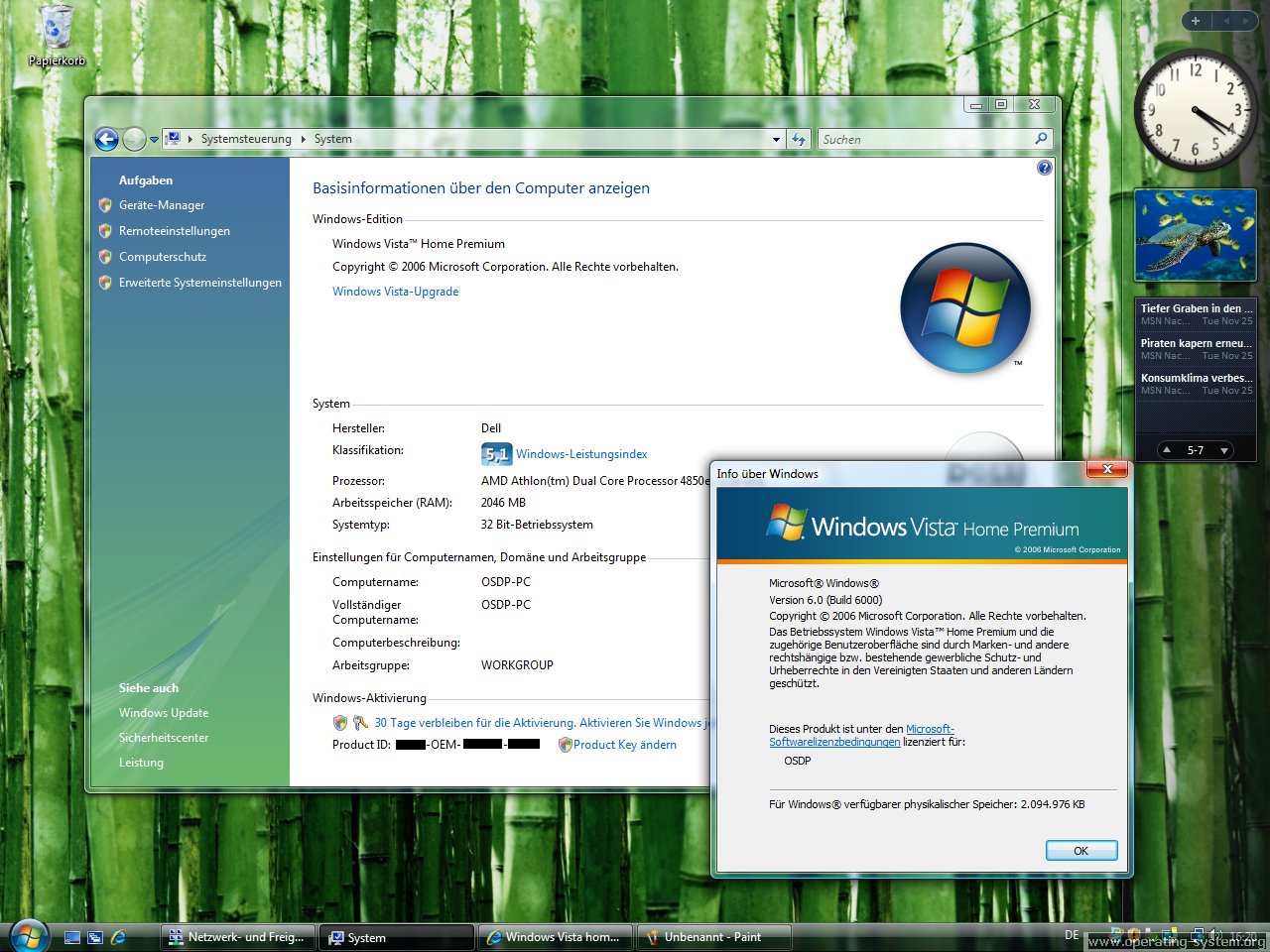
| Windows Vista, security center for firewall, update, virus protection and more | Windows Vista, computer benchmark | Windows Vista, change of the Windows appearance | Windows Vista, basic informations and version |
 |  |  |  |
| Windows Vista, user account control | Windows Vista, Internet Explorer 7 | Windows Vista, switch through the program pile | Windows Vista, normal program switch |
 |  |  | |
| Windows Vista, system files and junction points, command prompt | Windows Vista, task manager and resource monitor | Windows Vista, Windows Firewall, extended security |
Date - Version
2004 May - Windows Longhorn build 40742005 April - Windows Longhorn build 50482005 July - Beta 12006 June - Beta 2 (build 5384.4)2007 Jan. - Windows Vista released, Version 6.0 Build 60002008 March - Windows Vista Service Pack 1 (Version 6.0.6001)2009 May - Windows Vista Service Pack 2 (Version 6.0.6002)2017 April - Windows Vista Support discontinued